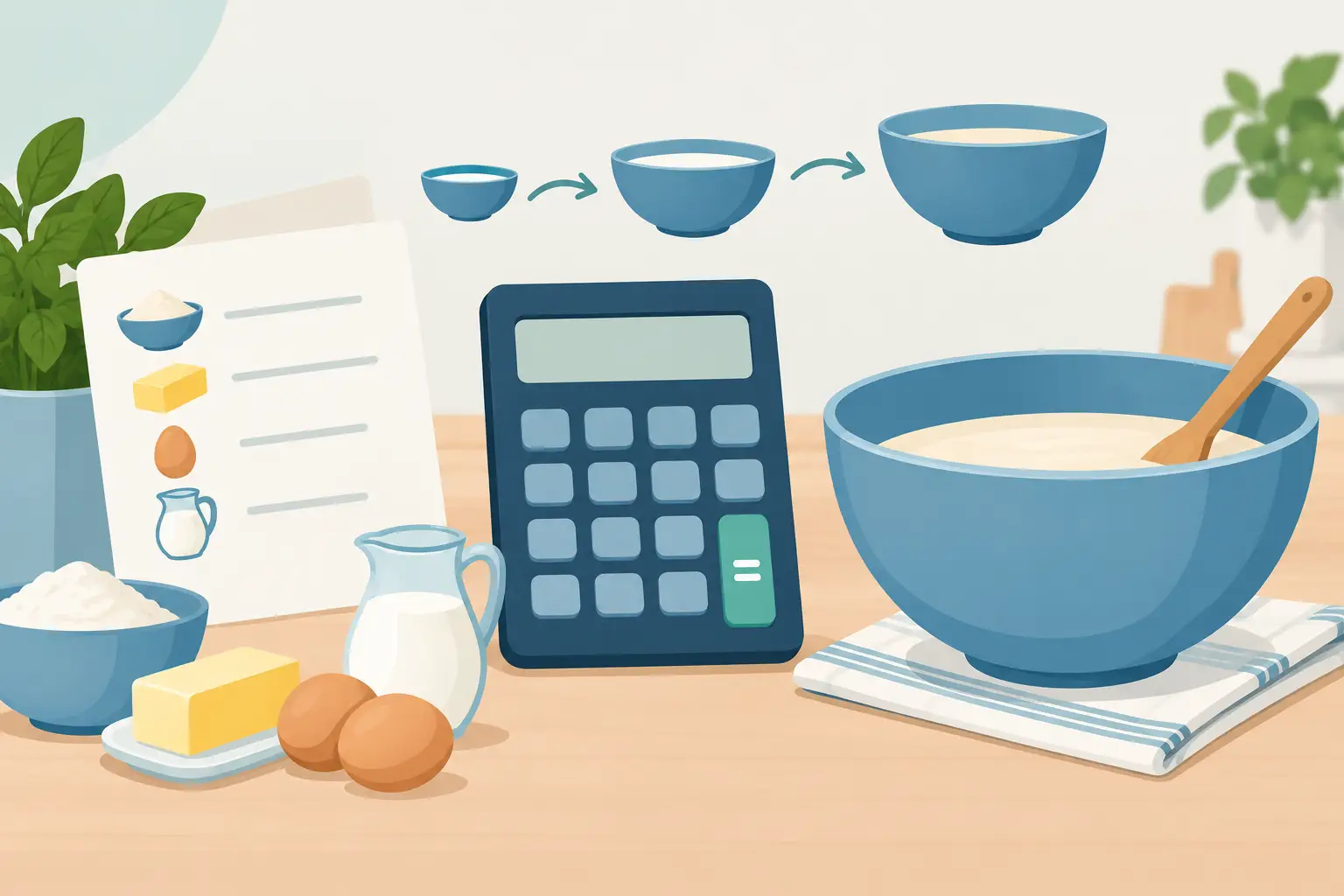
A dinner recipe written for four can become a problem when eight people are arriving in an hour, or when you only need lunch for one. A ratio calculator recipe scaling approach gives you one clear number to multiply by, so every ingredient stays in balance without doing a separate guess for each measurement.
Start With the Recipe Scaling Ratio
The scaling ratio compares the number of servings you want with the number of servings the original recipe makes.
The formula is simple:
Scaling factor = desired servings ÷ original servings
If a chili recipe serves 6 and you need 10 servings, divide 10 by 6. Your scaling factor is 1.67. Multiply each ingredient by 1.67 to make the larger batch.
For example, 2 pounds of ground beef becomes about 3.33 pounds. A 15-ounce can of tomatoes becomes 25 ounces. In real cooking, you can round that to two 15-ounce cans, then decide whether the extra 5 ounces of tomatoes would improve the texture or make the chili too thin.
That last step matters. A calculator provides the correct proportional answer, but cooking still benefits from common sense. Packaged ingredients, pan size, cooking time, and personal taste can affect the final choice.
How to Scale a Recipe Up or Down
Use the same process whether you are making more food or less. First, confirm the recipe's stated yield. Some recipes say they serve 4, while others list 12 cookies, 2 loaves, or one 9-inch cake. Then choose the amount you actually need.
Once you have the scaling factor, multiply every measured ingredient by it. This includes the main ingredients as well as salt, spices, oil, and liquid. Skipping the smaller ingredients is one of the most common reasons a scaled recipe tastes flat or unbalanced.
Suppose pancake batter makes 12 pancakes and you want 18. Divide 18 by 12 to get 1.5. If the original recipe calls for 1 cup of milk, use 1.5 cups. If it calls for 2 tablespoons of melted butter, use 3 tablespoons. If it calls for 1 teaspoon of baking powder, use 1.5 teaspoons.
Scaling down works the same way. To make 6 pancakes from that 12-pancake recipe, divide 6 by 12. The factor is 0.5, so use half of each ingredient.
A recipe scaling calculator is especially useful when the answer is not a clean half, double, or triple. Fractions such as 0.67 or 1.25 are accurate, but they are easy to misread when you are measuring several ingredients at once.
Keep Measurement Units Consistent
Multiply using the units already in the recipe whenever possible. If an ingredient is listed in cups, calculate in cups. If meat is listed in pounds, keep it in pounds. Switching units midway creates more work and increases the chance of an error.
You may need a practical conversion after calculating. For instance, 0.75 tablespoon equals 2.25 teaspoons. Since tablespoon measuring spoons are not usually marked in quarters, measuring 2 teaspoons plus 1/4 teaspoon is easier.
For baking, a kitchen scale can make scaling more accurate. Grams are especially helpful for flour, sugar, chocolate, and small quantities of yeast. A result such as 83.3 grams is much easier to use than trying to estimate a fraction of a cup.
Ingredients That Need Judgment, Not Just Math
Most ingredients can be scaled directly, but a few deserve extra attention. Recipes are systems, and not every part responds perfectly to multiplication.
Eggs and Leavening
Eggs can be awkward when a smaller batch calls for half an egg or one-third of an egg. Crack the egg into a bowl, whisk it well, and measure the portion you need. A large egg without its shell is roughly 3 tablespoons, although weighing it is more precise.
Baking powder, baking soda, and yeast should generally follow the calculated ratio, especially in cakes, breads, and muffins. However, very large batches may rise differently because heat moves more slowly through a bigger pan or dough mass. If you are multiplying a delicate baking recipe several times, separate it into multiple standard-size pans instead of using one oversized pan.
Salt, Spices, and Heat
Salt and seasoning are not always best handled with blind precision. Start with the calculated amount, but consider the recipe and the ingredients. A soup reduced during cooking may become saltier than expected. A chili made with different brands of canned tomatoes, broth, or beans may need less added salt.
Spicy ingredients deserve the same care. If you are making a batch three times larger, you can begin with two to two-and-a-half times the hot pepper or cayenne, then taste and adjust. You can add heat later. Taking it out is much harder.
Cooking Time and Equipment
More food does not automatically mean cooking three times as long. A double batch of cookies usually needs the same baking time per tray, but it requires more trays and may need rotation for even browning. A larger pot of soup may take longer to reach a simmer, yet the simmering time for tender vegetables can remain close to the original.
Your equipment sets real limits. Do not crowd a skillet simply because the math says to double the ingredients. Meat may steam instead of brown, and roasted vegetables may turn soft instead of caramelized. Cook in batches when needed, then combine everything at the end.
A Real-World Recipe Scaling Example
Imagine a pasta salad recipe that serves 4. It uses 8 ounces of pasta, 1 cup of chopped vegetables, 1/2 cup of dressing, 1/4 cup of cheese, and 2 tablespoons of herbs. You need enough for 14 people at a family gathering.
Divide 14 by 4. The scaling factor is 3.5.
Multiply each amount by 3.5. You will need 28 ounces of pasta, 3.5 cups of vegetables, 1.75 cups of dressing, 0.875 cup of cheese, and 7 tablespoons of herbs. For shopping and prep, you might round the pasta to 2 pounds and use 1 cup of cheese. Keep the dressing slightly under the calculated amount at first, because pasta salad can become too wet if it sits before serving. Reserve a little dressing to stir in just before the meal.
This example shows why recipe scaling is more than multiplying numbers. The ratio protects the recipe's starting balance, while a few sensible adjustments help it work in the real kitchen.
Common Recipe Scaling Mistakes
The biggest mistake is confusing servings with portions. A recipe labeled “serves 4” may provide four side-dish portions, not four full dinners. Think about who is eating, what else you are serving, and whether you want leftovers before choosing your target number.
Another mistake is scaling only the ingredients that feel important. If you double the chicken but forget to double the sauce, the dish may be dry. If you double the rice but not the broth, it may not cook properly.
Finally, watch for recipes built around a fixed container. A pie filling can be scaled, but a single pie crust only fits one pie plate. A cake recipe may need additional pans, not just more batter in the same pan. The calculator handles the quantity. You still need enough space for the food to cook correctly.
When a Ratio Calculator Makes Meal Planning Easier
Recipe scaling is useful well beyond holiday meals. It helps when you are packing lunches for the week, adjusting a meal for a smaller household, planning a potluck, or using up a specific amount of an ingredient before it expires. It can also reduce waste. Instead of cooking a recipe's full yield and hoping leftovers get eaten, you can make a quantity that fits your plans.
For meal prep, calculate servings first, then check package sizes. If a scaled recipe needs 1.8 pounds of chicken but the store package is 2 pounds, buying the full package may be practical. You can either use it all and make a slightly larger batch or save the small remainder for another meal. That choice depends on your budget, storage space, and how exact the recipe needs to be.
Good cooking does not require perfect mental math. It requires a reliable starting point and a willingness to adjust when the pan, package, or taste test calls for it. Use the ratio to get the quantities right, then let your kitchen judgment finish the job.