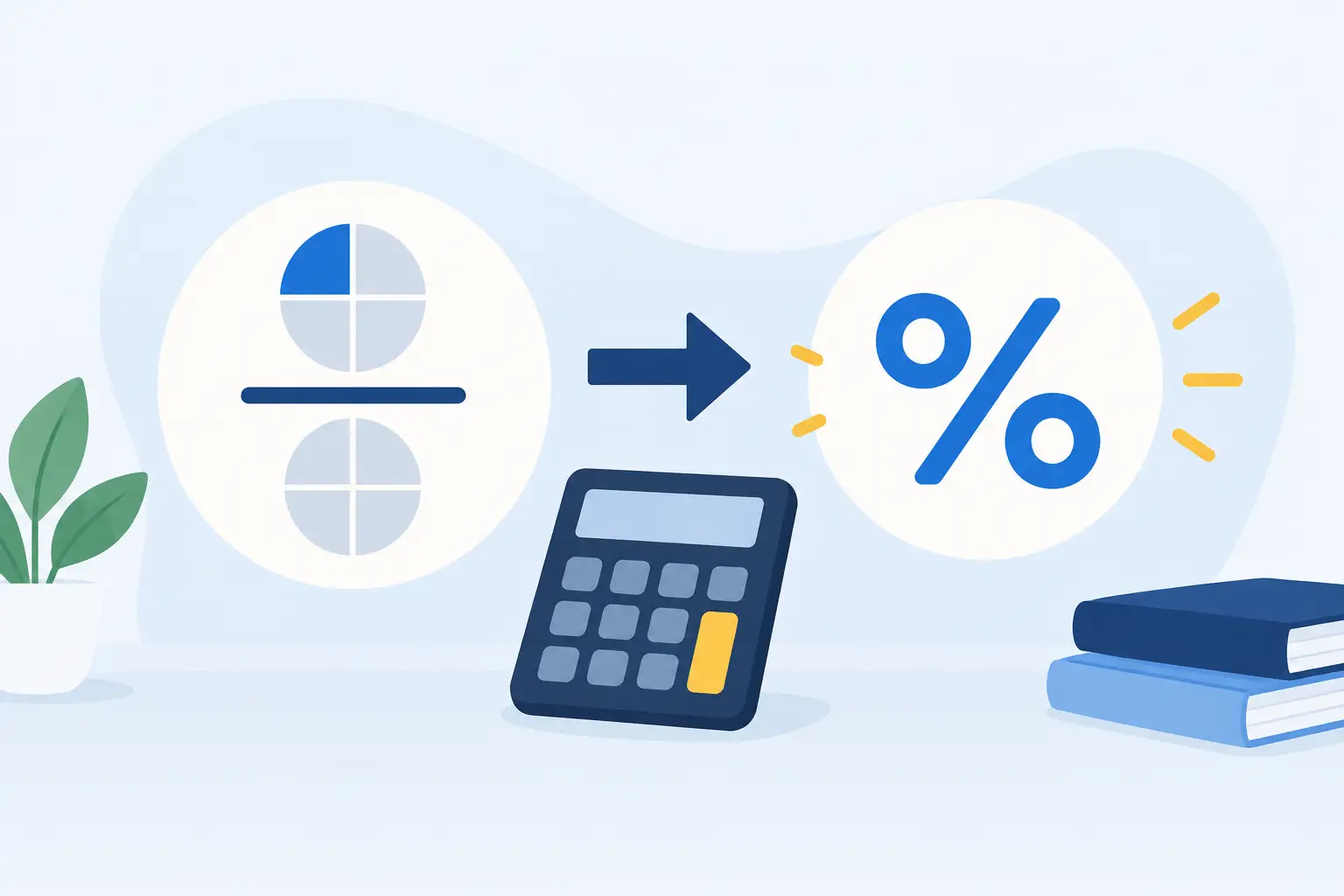
A quiz score of 17/20, a 3/8 discount, or a recipe that uses 1/4 cup all describe parts of a whole. When you convert fractions to percentages, those parts become easier to compare, explain, and use in everyday decisions. The calculation is simple once you know what the denominator represents.
How to Convert Fractions to Percentages
A percentage means “out of 100.” The percent symbol, %, is another way of saying per hundred. So converting a fraction to a percentage means finding an equivalent amount with 100 as the denominator.
The reliable formula is:
Fraction ÷ denominator, then multiply by 100
Written another way:
(Numerator ÷ Denominator) × 100 = Percentage
The numerator is the top number in a fraction. The denominator is the bottom number. For the fraction 3/4, 3 is the numerator and 4 is the denominator.
Start by dividing 3 by 4:
3 ÷ 4 = 0.75
Then multiply the decimal by 100:
0.75 × 100 = 75
Add the percent sign: 3/4 = 75%.
You can also think of multiplying by 100 as moving the decimal point two places to the right. A decimal of 0.75 becomes 75%. A decimal of 0.08 becomes 8%.
A Quick Method That Works for Any Fraction
The divide-and-multiply method works whether the fraction is familiar or unusual. Suppose you need to convert 7/16 to a percentage.
First, divide the numerator by the denominator:
7 ÷ 16 = 0.4375
Next, multiply by 100:
0.4375 × 100 = 43.75
So, 7/16 = 43.75%.
This is especially useful for school grades, test results, survey responses, discounts, and financial comparisons. If 7 out of 16 customers choose an option, saying 43.75% chose it is often clearer than leaving the result as a fraction.
A calculator can speed up the process. Enter the numerator, divide by the denominator, and multiply the result by 100. For a direct answer without setting up the formula yourself, CalculatorWonder’s percentage tools can help turn a ratio into a readable percentage in seconds.
Convert Fractions to Percentages by Making 100
Some fractions can be converted quickly without division because their denominators can easily become 100. Multiply the numerator and denominator by the same number. This keeps the value of the fraction unchanged.
For example, convert 3/5 to a percentage. Because 5 × 20 = 100, multiply both parts of the fraction by 20:
3/5 = 60/100 = 60%
For 7/25, multiply both numbers by 4:
7/25 = 28/100 = 28%
This approach is convenient for fractions with denominators such as 2, 4, 5, 10, 20, 25, 50, and 100. It may be faster than decimal division, but it is not necessary. The formula works every time, including when the denominator does not divide neatly into 100.
For instance, 2/3 cannot be written as an exact fraction over 100 using whole numbers. Dividing gives 0.6666 repeating, so 2/3 = 66.6666...%. Depending on why you need the answer, you might report it as 66.7% or 67%.
Common Fraction-to-Percentage Conversions
A few common values are worth recognizing because they appear often in budgeting, sales, schoolwork, measurements, and probability.
| Fraction | Decimal | Percentage | | --- | ---: | ---: | | 1/2 | 0.5 | 50% | | 1/4 | 0.25 | 25% | | 3/4 | 0.75 | 75% | | 1/5 | 0.2 | 20% | | 2/5 | 0.4 | 40% | | 3/5 | 0.6 | 60% | | 1/8 | 0.125 | 12.5% | | 3/8 | 0.375 | 37.5% | | 1/10 | 0.1 | 10% |
These are useful benchmarks. If a store advertises 25% off, that is the same as taking away one-quarter of the original price. If you have completed 3/5 of a project, you are 60% finished.
What to Do With Improper Fractions and Mixed Numbers
Fractions do not always represent less than one whole. An improper fraction has a numerator that is greater than or equal to its denominator, such as 9/4. Its percentage will be 100% or more.
Use the same formula:
9 ÷ 4 = 2.25
2.25 × 100 = 225%
So, 9/4 = 225%. This means two and one-quarter wholes, not a mistake. Percentages above 100% are common when comparing a value with a baseline. For example, earning 225% of a monthly target means the target was exceeded by 125%.
For a mixed number, convert it to an improper fraction first or convert its parts separately. Consider 1 1/2:
1 1/2 = 3/2
3 ÷ 2 = 1.5
1.5 × 100 = 150%
Therefore, 1 1/2 = 150%.
When Should You Round the Percentage?
Some fractions produce repeating decimals. One-sixth equals 0.166666..., which becomes 16.6666...%. There is no single right way to round it because the best choice depends on how the percentage will be used.
For a quick estimate, 16.7% is usually enough. For a classroom answer, follow the teacher’s requested number of decimal places. For money, keep enough decimals during the calculation and round the final dollar amount according to the situation. Rounding 16.666...% to 17% may be fine for a chart, but it can be too rough for a detailed report or a large financial total.
If several rounded percentages need to add up to exactly 100%, small differences can appear. For example, three equal groups each represent 33.333...%. Displaying all three as 33.3% totals 99.9%, while displaying each as 33% totals 99%. Keep the unrounded values for the calculation, then choose display rounding that makes sense for the reader.
Avoid These Common Mistakes
The most frequent error is dividing the denominator by the numerator. For 3/4, calculating 4 ÷ 3 gives 1.333..., or 133.33%. That is the percentage for 4/3, not 3/4. Read the fraction from top to bottom: numerator divided by denominator.
Another mistake is stopping at the decimal. If 5 ÷ 8 equals 0.625, that is not yet the percentage. Multiply by 100, or move the decimal two places right, to get 62.5%.
It also helps to remember that the percent sign changes the meaning of a number. Writing 0.625% instead of 62.5% makes the result 100 times smaller. A quick reasonableness check can catch this: because 5/8 is greater than one-half, its percentage must be greater than 50%.
Use Estimation to Check Your Answer
You do not need to memorize every conversion to spot an unlikely answer. Compare the fraction with familiar reference points.
A fraction close to 1/2 should be near 50%. A fraction close to 1/4 should be near 25%, and one close to 3/4 should be near 75%. For example, 11/12 is just below one whole, so its percentage should be just below 100%. The exact calculation is 91.67%, which fits that expectation.
For 2/9, the result should be a little above 20%, because 1/9 is about 11.1%. Dividing 2 by 9 gives 0.2222..., or 22.22%. Estimation will not replace the calculation, but it gives you a fast check before you use the answer in a grade, budget, or purchase decision.
The next time a fraction appears in a score, price, recipe, or report, divide the top number by the bottom number and multiply by 100. One small calculation can turn a hard-to-read ratio into an answer that is easy to compare and act on.