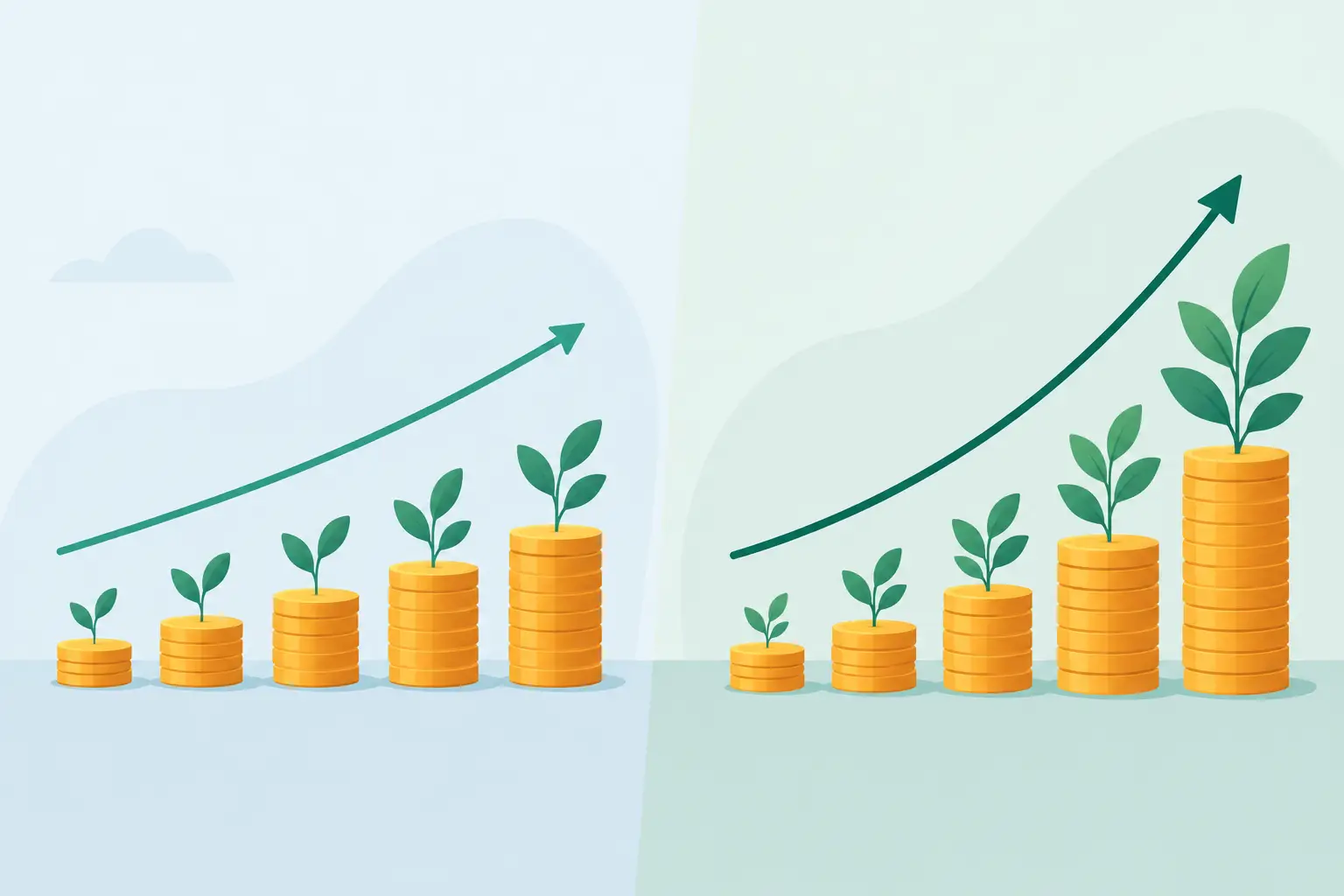
A 6% rate can mean very different things depending on how interest is calculated. That is the practical difference behind simple versus compound interest: one method pays interest only on the original amount, while the other earns or charges interest on prior interest too.
For a short-term loan or a small savings balance, the gap may seem minor. Over several years, especially with regular deposits or a high balance, it can become a meaningful part of your financial plan. Knowing which method applies helps you compare accounts, understand borrowing costs, and estimate what your money can do over time.
What Is Simple Interest?
Simple interest is calculated only from the original principal. The principal is the starting amount you borrow, invest, or deposit. Interest does not get added back into the calculation for future periods.
The basic formula is:
Simple interest = Principal × Rate × Time
In formula form, that is: I = P × r × t.
For example, imagine you put $5,000 into an account that pays 6% simple interest for three years. The annual interest is $300, because $5,000 × 0.06 equals $300. After three years, you would earn $900 in interest, leaving you with $5,900 total.
The key feature is consistency. You earn the same dollar amount each year because the calculation always starts with the same $5,000 principal.
Simple interest is often used for certain personal loans, auto loans, short-term loans, and some bonds or certificates. However, the label alone does not tell you everything. A loan may use simple interest while calculating it daily on the unpaid balance. Your payment schedule still matters because paying down principal sooner reduces the balance used for future interest charges.
What Is Compound Interest?
Compound interest is calculated on the original principal plus interest already earned or added to the balance. In a savings account, this helps your money grow faster. In debt, it can make a balance cost more if you carry it for a long time.
The formula is:
A = P(1 + r/n)^(nt)
Here, A is the final amount, P is the principal, r is the annual interest rate as a decimal, n is the number of times interest compounds each year, and t is the number of years.
Using the same $5,000 example at 6% for three years, compounded annually, the results look different. After year one, the balance is $5,300. In year two, the 6% interest is calculated on $5,300, not $5,000. By the end of year three, the account would be worth about $5,955.08.
That is $55.08 more than simple interest over only three years. The difference grows as the balance, rate, and time period increase. It also grows when interest compounds more often.
Savings accounts, certificates of deposit, retirement accounts, and investment accounts can benefit from compounding. Credit cards, some loans, and unpaid account balances can work against you through compounding charges.
Simple Versus Compound Interest at a Glance
The simplest way to compare the two is to focus on the balance used in each new calculation.
With simple interest, each period begins with the original principal. A $10,000 balance at 5% earns $500 per year in simple interest, regardless of how long it remains invested.
With compound interest, each period begins with a larger balance if prior interest remains in the account. That same $10,000 at 5%, compounded annually, becomes $10,500 after one year. The next year’s interest is based on $10,500, so it earns $525 rather than $500.
Neither type is automatically better in every situation. As a saver or investor, compound interest is usually favorable because it increases your returns. As a borrower, simple interest is often easier to predict, but the total cost depends on the rate, fees, repayment term, and whether the interest is charged daily, monthly, or another way.
Why Compounding Frequency Matters
Compound interest does not always compound once a year. Depending on the account or debt, it may compound monthly, daily, quarterly, or continuously. More frequent compounding generally means slightly more interest earned on savings and slightly more interest charged on debt, assuming the stated annual rate stays the same.
Suppose $10,000 earns 5% for one year. Compounded annually, it grows to $10,500. Compounded monthly, it grows to about $10,511.62. The difference for one year is modest, but it becomes larger over long periods or with larger balances.
This is why the annual percentage yield, or APY, is helpful when comparing deposit accounts. APY reflects the effect of compounding over one year. A savings account advertising a 5% APY gives you a clearer picture of yearly earnings than a 5% annual percentage rate, or APR, by itself.
For loans and credit products, APR is commonly used to describe the annual cost of borrowing, though it may not reflect every possible fee or the effect of a revolving balance. Read the account terms to see how interest accrues and when it may compound.
A Longer Example: Time Changes the Result
Time is where compound interest becomes easier to see. Consider $10,000 earning 7% for 20 years, with no additional deposits.
At simple interest, the calculation is straightforward: $10,000 × 0.07 × 20 equals $14,000 in interest. The final amount is $24,000.
At 7% compound interest compounded annually, the account grows to about $38,697. The interest earned is about $28,697, more than double the simple-interest result.
The rate did not change. The original deposit did not change. The major difference is that compound interest gave each year’s earnings a chance to earn more earnings in later years.
Regular contributions can make this effect even stronger. Adding money monthly to a retirement or savings account gives each contribution its own time to compound. Earlier deposits have more time to grow, which is one reason starting with a manageable amount now can be more valuable than waiting for the “perfect” time to begin.
How Interest Works on Common Types of Debt
Borrowing terms can be confusing because products do not always use the same interest method.
A typical auto loan is often described as a simple-interest loan. Interest accrues on the remaining principal, often daily. If you make payments on time, each payment reduces the principal over time and lowers future interest charges. Paying extra toward principal can reduce the total interest paid and may shorten the loan term, if your loan has no prepayment penalty.
A fixed-rate mortgage usually uses an amortization schedule. Each monthly payment includes interest based on the outstanding loan balance and principal that reduces that balance. Early payments generally include more interest because the balance is larger. Later payments shift more heavily toward principal.
Credit cards can be less forgiving. If you carry a balance past the grace period, interest may accrue daily, and unpaid interest can effectively become part of the amount on which future charges are calculated. The rate, payment amount, and payment timing all affect how quickly the balance grows or shrinks.
The practical takeaway is not to assume that “simple interest” means inexpensive or that “compound interest” always means expensive. Compare the full terms and model the actual payment schedule.
How to Calculate the Right Number for Your Decision
Before calculating interest, gather the details that control the result: the starting balance, annual rate, time period, compounding frequency, and planned deposits or payments. For a loan, also check whether there are origination fees, late fees, a promotional rate, or a prepayment rule.
For simple interest, calculate the interest amount first, then add it to the principal for a savings balance or add it to the borrowing cost. For compound interest, use the compounding formula or a calculator that lets you enter the deposit amount, rate, timeline, and frequency.
When comparing savings options, use APY when it is available because it accounts for compounding. When comparing loans, look beyond the monthly payment. A lower payment can come from a longer term, which may increase the total interest paid.
A compound interest calculator can make these comparisons quick without building a spreadsheet. Try changing one input at a time, such as adding $50 per month, raising the rate by one percentage point, or making an extra loan payment. Seeing the difference in dollars can make a decision much clearer.
Use Interest Knowledge to Set Your Next Move
Interest is not just a formula on a statement. It is a cost when you borrow and a growth tool when you save. If you have high-rate revolving debt, reducing the balance can prevent future interest from building on itself. If you are saving for a goal, even small automatic contributions can give compounding more time to work.
The most useful calculation is the one that reflects your real timeline and habits. Enter the numbers you have, test a few realistic scenarios, and choose the next step that makes your money work harder for you.