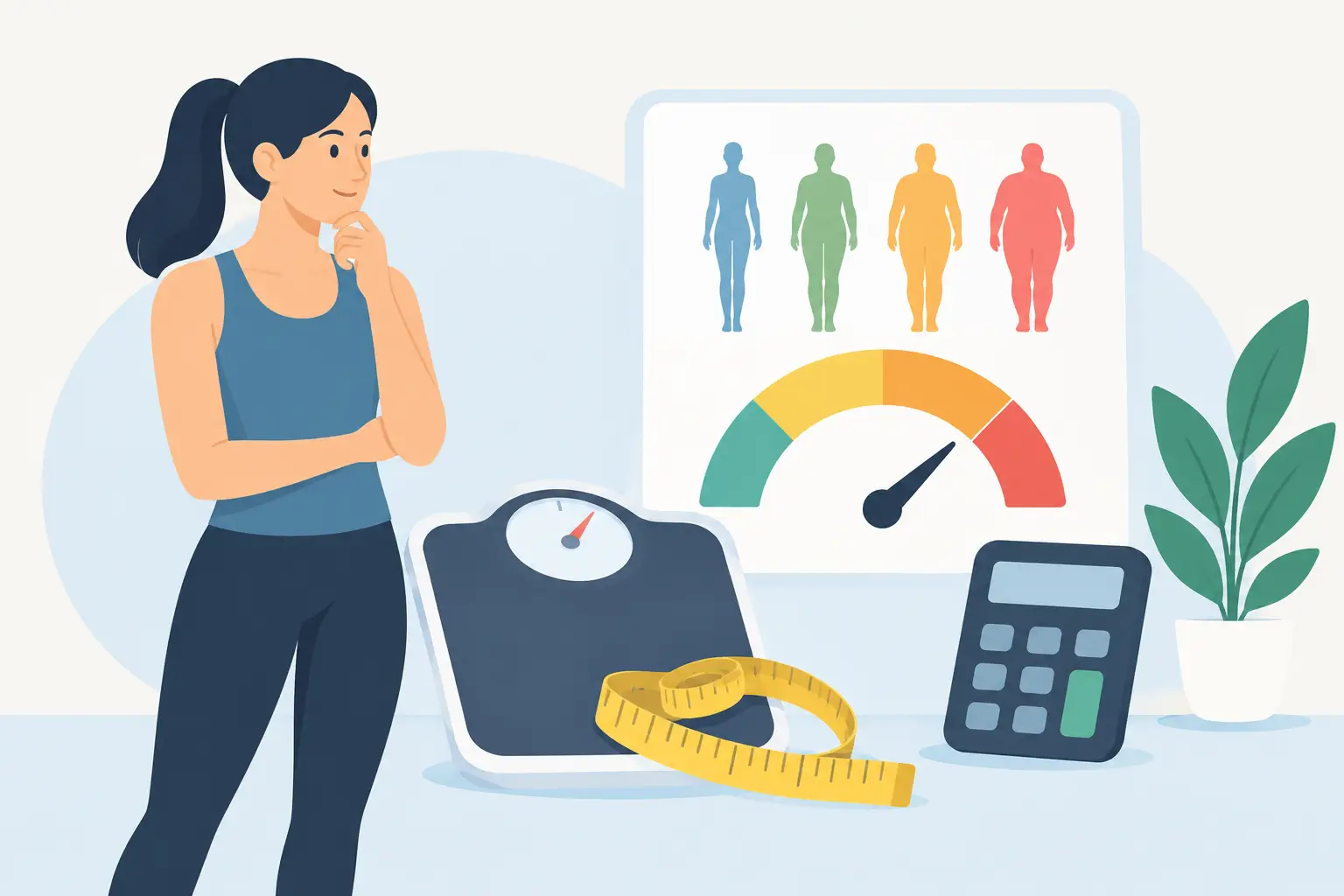
A BMI result can take seconds to get, but it helps to know what the number represents before using it to set a health goal. So, how is BMI calculated? It compares your weight with your height using one standard formula. The result is a screening measurement, not a complete picture of your health.
BMI stands for body mass index. It is commonly used by doctors, insurers, researchers, and individuals because it offers a quick, consistent way to identify whether a person’s weight may be in a range associated with higher health risks. You only need two inputs: height and weight.
How Is BMI Calculated From Height and Weight?
The formula depends on the units you use.
In the metric system, BMI is calculated as:
BMI = weight in kilograms ÷ height in meters squared
In U.S. customary units, the formula is:
BMI = weight in pounds ÷ height in inches squared × 703
The number 703 is a conversion factor that makes the pounds-and-inches calculation match the metric result. This is why the formula may look slightly more complicated when you use feet, inches, and pounds.
Height is squared, meaning it is multiplied by itself. For example, a height of 68 inches becomes 68 × 68, or 4,624. That squared height is then used to adjust weight for a person’s frame size. BMI is not simply a weight number. The same weight can produce very different BMI results for people of different heights.
Example Using Pounds and Inches
Suppose a person weighs 180 pounds and is 5 feet 9 inches tall. First, convert the height to total inches: 5 feet is 60 inches, plus 9 inches, for a total of 69 inches.
Next, use the formula:
BMI = 180 ÷ (69 × 69) × 703
The height squared is 4,761. Dividing 180 by 4,761 gives about 0.0378. Multiply that by 703, and the BMI is about 26.6.
BMI is typically shown to one decimal place. A calculator handles the arithmetic immediately, which can help avoid common errors such as forgetting to square your height or using feet and inches separately.
Example Using Kilograms and Meters
Now consider a person who weighs 75 kilograms and is 1.75 meters tall.
BMI = 75 ÷ (1.75 × 1.75)
The height squared is 3.0625. Divide 75 by 3.0625, and the BMI is approximately 24.5.
Both examples use the same underlying method. The only difference is the measurement system.
What Do Adult BMI Results Mean?
For most adults age 20 and older, BMI is generally grouped into four standard categories. A BMI below 18.5 is considered underweight. A BMI from 18.5 to 24.9 is considered a healthy weight range. A BMI from 25.0 to 29.9 is considered overweight, and a BMI of 30.0 or higher is classified as obesity.
These ranges are useful for screening, especially when tracking changes over time. For example, if your BMI gradually rises over several years, that may be a practical signal to review activity habits, food choices, sleep, stress, medications, or other factors that affect weight.
A category is not a diagnosis, though. A BMI of 25.1 does not suddenly mean your health changed compared with a BMI of 24.9. The cutoffs are tools for assessing risk across large groups of people. Your personal health picture also includes blood pressure, cholesterol, blood sugar, family history, fitness level, and other measures.
Why BMI Uses Height Squared
At first, dividing weight by height squared can seem arbitrary. The goal is to create a ratio that accounts for the fact that taller people naturally tend to weigh more than shorter people. If BMI used weight alone, it would label many tall people as heavier without considering their height.
Height is squared because it creates a useful relationship between height and body mass for population-level screening. It is not a direct measurement of body fat, muscle, bone density, or body shape. Instead, it is a fast estimate that helps identify when a closer look may be worthwhile.
This trade-off is a major reason BMI remains widely used. It is easy to calculate, requires no equipment beyond a scale and height measurement, and makes broad comparisons possible. At the same time, its simplicity means it cannot explain everything about an individual body.
When BMI May Need More Context
BMI can be less precise for certain people and situations. Athletes and people who do substantial strength training may have a higher BMI because muscle weighs more than fat by volume. Their result could fall into an overweight or obesity category even when they have a low body-fat percentage and strong cardiovascular health.
Older adults may have a BMI in a typical range while carrying less muscle and more body fat than the number suggests. Pregnancy also changes body weight in ways BMI is not designed to evaluate. Children and teenagers use BMI differently, because their body composition changes as they grow. Their results are interpreted using BMI-for-age percentiles based on age and sex, not adult category cutoffs.
Ethnicity can matter as well. Research shows that health risks linked to body fat distribution can occur at different BMI levels among different populations. For that reason, a healthcare professional may consider additional measures, particularly if you have risk factors for heart disease or diabetes.
Waist circumference is one helpful companion measurement because abdominal fat can be associated with metabolic risk. A clinician may also consider body-fat percentage, blood test results, blood pressure, medications, and how you feel during normal activity. No single number can replace that broader context.
How to Measure Height and Weight More Accurately
BMI is only as accurate as the numbers you enter. For a useful result, measure height without shoes, standing straight against a wall if possible. Record your height in inches or centimeters rather than estimating from memory.
For weight, use a reliable scale on a flat, hard surface. Weigh yourself at roughly the same time of day if you are monitoring trends. Morning measurements, after using the restroom and before breakfast, tend to be more consistent from day to day.
Small changes in weight are normal. Hydration, meals, exercise, sodium intake, and clothing can all affect the scale. Rather than reacting to one reading, look at the pattern across several weeks or months. That approach is more useful for decisions about everyday habits.
BMI for Tracking, Not Judging
BMI works best as a practical starting point. It can help you understand your current weight-to-height ratio, discuss concerns with a healthcare professional, or track whether a long-term change in weight is moving in the direction you intended.
It should not be used to judge appearance, fitness, or personal effort. Two people can share the same BMI and have different muscle mass, lifestyles, medical histories, and health needs. A result is information, not a verdict.
If you want a fast answer, enter your current height and weight into a BMI calculator and use the result as one piece of your health picture. The most useful number is the one that helps you ask a better next question, whether that means checking a trend, building sustainable habits, or speaking with a qualified professional.