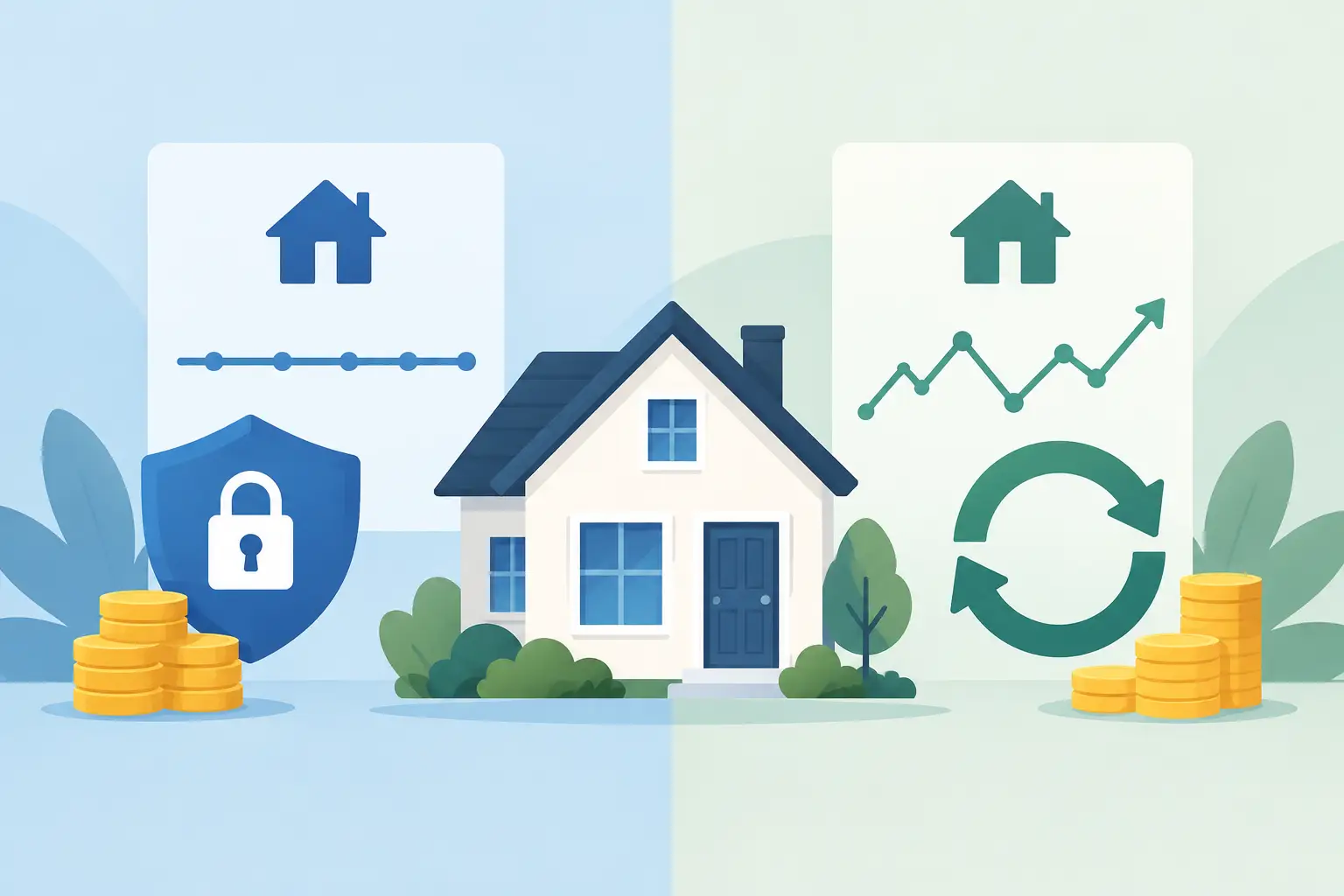
A fixed versus adjustable mortgage decision can change both your monthly payment and how predictable homeownership feels over time. The right answer is rarely about finding the lowest rate advertised today. It depends on how long you expect to keep the loan, how much payment change your budget can handle, and whether certainty matters more to you than a lower starting cost.
For many buyers, the mortgage is the largest recurring expense in the household budget. Understanding how each option works before comparing lenders can make the decision much clearer.
How fixed-rate mortgages work
A fixed-rate mortgage keeps the same interest rate for the full loan term. If you choose a 30-year fixed mortgage, your principal-and-interest payment stays the same for 30 years, assuming you do not refinance. A 15-year fixed mortgage works the same way, but its shorter repayment period usually comes with a higher monthly payment and less total interest paid over the life of the loan.
Your total monthly housing payment can still change. Property taxes, homeowners insurance, mortgage insurance, and homeowners association dues may rise or fall. But the loan's principal-and-interest portion remains predictable.
That predictability is the main benefit. You know what the core payment will be next year and many years from now. A fixed rate can be especially helpful when you plan to stay in the home for a long time, expect your income to grow slowly, or prefer a budget with fewer surprises.
The trade-off is that fixed mortgage rates are often higher than the initial rate on an adjustable-rate mortgage. You may pay more each month at the beginning in exchange for protection against future rate increases. If market rates fall, you would need to refinance to get a lower rate, and refinancing brings closing costs and qualification requirements.
How adjustable-rate mortgages work
An adjustable-rate mortgage, often called an ARM, starts with a fixed interest rate for a set period. After that introductory period ends, the rate can adjust at scheduled intervals based on a market index plus a lender-set margin.
A common example is a 5/6 ARM. The first number means the initial rate is fixed for five years. The second number means the rate may adjust every six months after that. A 7/6 ARM stays fixed for seven years before adjustments begin. Some loans use annual adjustment periods instead.
Because the lender is not locking in one rate for the entire term, an ARM often starts with a lower interest rate than a comparable fixed loan. That can reduce the initial monthly payment and may help a buyer qualify for a home within a set budget.
The risk begins when the fixed period ends. If interest rates have risen, your payment may increase. If rates have declined, your payment could decrease. The future payment is not guaranteed, which is why it is essential to look beyond the starting rate.
ARM caps limit changes, but do not eliminate risk
ARMs generally include caps that limit how much the interest rate can change. Your loan estimate should show three important limits: the initial adjustment cap, the periodic adjustment cap, and the lifetime cap.
For example, a 5/2/5 cap structure means the rate can rise by up to 5 percentage points at its first adjustment, by up to 2 points at later adjustments, and by no more than 5 points above its original rate over the life of the loan. These limits provide boundaries, but a payment increase can still be significant.
Before choosing an ARM, calculate the payment at the highest possible rate allowed by the lifetime cap. If that payment would put pressure on your finances, the lower initial payment may not be worth the uncertainty.
Fixed versus adjustable mortgage: the key differences
The clearest difference is certainty. A fixed-rate mortgage gives you a stable interest rate and predictable principal-and-interest payment. An adjustable-rate mortgage gives you a lower rate for a limited time, followed by potential payment changes.
The better initial deal is often the ARM, but the better long-term deal is not always obvious. A lower ARM payment can free up cash for savings, repairs, or other goals during the introductory period. Yet a fixed loan may cost less overall if rates rise sharply and you remain in the home for many years.
Your expected timeline matters. If you are confident you will sell the home or refinance before the ARM begins adjusting, an ARM may be a practical way to reduce early costs. Still, plans change. A job move can fall through, home prices can shift, or refinancing can become harder if rates rise, credit changes, or the home's value drops.
A fixed mortgage usually suits buyers who want to put down roots, have little room for a higher payment, or value financial consistency. An ARM may suit buyers with a short, realistic ownership timeline, strong savings, and enough income flexibility to manage a higher payment if needed.
Compare the payment, not just the rate
A mortgage rate is only one number. To make a useful comparison, use the same home price, down payment, loan term, and estimated taxes and insurance for both loan options. Then compare the monthly payment during the fixed period, the payment after a possible adjustment, and the total cash needed to close.
Suppose a buyer borrows $350,000. A 30-year fixed loan may have a higher starting rate than a 5/6 ARM, producing a higher monthly principal-and-interest payment from day one. The ARM could save several hundred dollars each month for five years. But if its rate increases when the fixed period ends, that earlier savings could shrink quickly.
Do not assume refinancing will always be available when you want it. Refinancing typically requires sufficient income, acceptable credit, and enough home equity. It also costs money. Treat refinancing as a possible option, not the plan that makes an otherwise risky loan safe.
When reviewing loan offers, pay attention to the annual percentage rate, or APR, as well as the interest rate. APR includes certain lender fees and can help you compare the broader cost of loans. Also ask whether the quoted rate requires discount points, which are upfront fees paid to lower the interest rate.
Questions to answer before choosing
Start with your housing timeline. Are you likely to stay in the home beyond the ARM's fixed period? If the answer is yes or uncertain, a fixed rate deserves serious consideration.
Next, test your budget. Could you comfortably make the ARM payment if the rate rose to its cap? A lender may approve a loan amount that is technically affordable on paper but leaves little room for repairs, childcare, medical bills, or a temporary income loss.
Consider your broader financial goals, too. An ARM's lower initial payment may be useful if you are building an emergency fund, paying off high-interest debt, or expect a reliable increase in income. That benefit should be weighed against the possibility of a higher payment later.
Finally, read the loan estimate carefully. Confirm the introductory rate period, adjustment schedule, index, margin, caps, closing costs, and any prepayment penalty. If a term is unclear, ask the lender to explain how it affects your payment in dollars.
A practical way to make the decision
Run two or three payment scenarios before you commit. First, compare the fixed loan payment with the ARM's introductory payment. Then estimate the ARM payment after a moderate rate increase and at its maximum allowed rate. CalculatorWonder's mortgage calculator can help turn those rate scenarios into monthly numbers without building a spreadsheet.
If the fixed payment fits your budget and you value certainty, paying a little more upfront may be the easier choice to live with. If the ARM offers meaningful savings and you have a well-supported plan to sell, refinance, or absorb a higher payment before adjustments begin, it may fit your situation.
The best mortgage is not the one with the lowest number on the first page. It is the one whose payment still works for your household when life does not go exactly as planned.