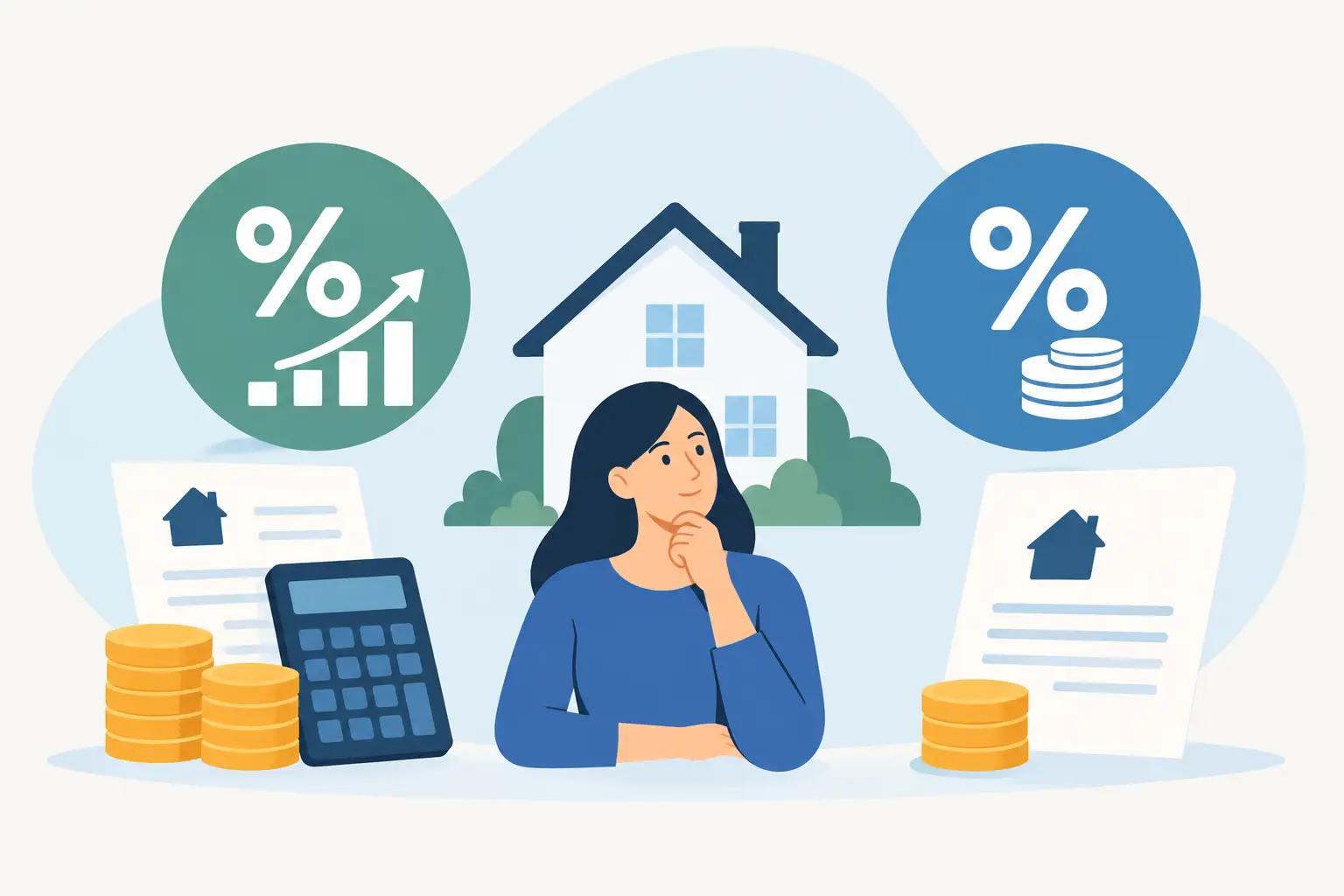
A lender advertises a 6.5% rate, but the paperwork shows a 6.9% APR. That gap can look small, especially when you are focused on the monthly payment. But understanding APR versus interest helps you see whether a loan is priced fairly and compare offers on more than the headline rate.
The quick answer is simple: the interest rate tells you the cost of borrowing the loan balance, while APR is designed to show a broader yearly cost that may include certain lender fees. Both numbers matter. Which one deserves more attention depends on the type of loan and how long you expect to keep it.
APR versus interest: the basic difference
An interest rate is the percentage charged on the amount you borrow. If you take out a $10,000 loan at 8% simple annual interest, the rate tells you how interest is calculated on the unpaid balance over time. The actual dollar amount you pay will also depend on the loan term, payment schedule, and whether interest compounds.
APR, or annual percentage rate, starts with the interest rate and may add certain prepaid finance charges, such as lender origination fees, discount points, or required processing fees. It expresses those costs as a yearly percentage so borrowers can compare loans more easily.
That is why APR is often higher than the interest rate. A loan with a 6.5% interest rate and upfront lender fees could show a 6.9% APR. The rate itself did not change. The APR reflects that you are paying more than interest alone to get the loan.
APR is not always higher. A lender may offer credits that reduce some closing costs, or a product may not have included finance charges that increase APR. Still, when comparing similar loans, a higher APR usually signals higher overall borrowing costs.
What the interest rate tells you
The interest rate is especially useful for estimating your payment and understanding how your balance will grow or shrink. On an installment loan, such as an auto loan, personal loan, or mortgage, interest is commonly calculated on the remaining principal balance. Early payments often send more money to interest because the balance is largest at the beginning.
For example, imagine two 30-year, $300,000 mortgages with no difference in fees. A rate of 6.5% produces a lower principal-and-interest payment than a rate of 6.75%. If all other details are equal, the lower rate is the less expensive choice.
Interest rates also matter because they affect the cost of keeping a loan for longer. A lower rate can save meaningful money over years, even if the monthly payment difference seems modest.
For savings accounts and investments, the word interest works differently from borrowing. You earn interest rather than pay it. In that setting, APY - annual percentage yield - is often more useful because it includes the effect of compounding. APR and APY should not be treated as interchangeable.
What APR includes and what it may leave out
APR gives borrowers a useful comparison tool, but it is not a complete list of every cost connected to a loan. What is included is governed by lending rules and the loan type. In many cases, APR includes charges paid to the lender or required to obtain the credit, but it may not include costs such as property taxes, homeowners insurance, or some third-party services.
With a mortgage, APR commonly reflects the note rate plus items such as points and certain origination charges. It generally does not represent your full monthly housing cost. Your mortgage payment may also include principal, interest, taxes, insurance, and possibly mortgage insurance.
With credit cards, the purchase APR tells you the annual rate that can apply to unpaid purchases. Cards can also have separate APRs for balance transfers and cash advances. Fees such as annual fees, late fees, and foreign transaction fees may still affect what you pay without being built into the advertised purchase APR.
For auto loans and personal loans, the APR can be a strong shortcut for comparing offers with similar amounts and terms. Read the fee details anyway. A low advertised rate may only be available to borrowers with excellent credit, while your approved offer could be different.
A simple loan comparison
Suppose you are choosing between two $20,000 personal loans, each repaid over five years.
Loan A has a 9.00% interest rate and a 9.00% APR, with no origination fee. Loan B has an 8.50% interest rate but charges a $700 origination fee. Its APR may be higher than Loan A's because the fee increases the true cost of receiving the loan.
Loan B may still show a slightly lower monthly payment if the payment calculation uses the full $20,000 balance. But if the $700 fee is taken from the proceeds, you receive only $19,300 while repaying a loan based on $20,000. APR helps expose that difference.
Now change the situation. If you need exactly $20,000 in your bank account, a loan that deducts a fee from the proceeds may require you to borrow more. That can raise both your payment and your total cost. Always look at the amount financed, the amount you will actually receive, the payment, and the total of payments - not just one percentage.
Why APR can be less useful when your plans change
APR calculations make assumptions about the loan term. This is particularly important with mortgages. A mortgage APR generally spreads upfront costs across the full scheduled repayment period. If you sell the home, refinance, or pay off the loan early, you may not keep the loan long enough for that calculation to match your real experience.
Consider two mortgage choices. One has a lower interest rate but requires several thousand dollars in points. The other has a slightly higher rate and lower closing costs. The lower-rate option may win if you keep the mortgage for many years. If you expect to move or refinance in two years, paying high upfront fees may not make sense.
A practical way to assess this trade-off is to calculate a break-even point. Divide the extra upfront cost by the monthly savings from the lower rate. If paying $3,000 in points saves $100 per month, the basic break-even point is about 30 months. Your plans can change, so treat that number as a decision aid, not a guarantee.
How to compare loan offers without getting lost
Start by comparing loans that have the same purpose, loan amount, and repayment term. An APR on a three-year loan is not directly comparable to an APR on a five-year loan if your goal is to minimize the monthly payment or total interest. The terms change the result.
Then check the interest rate, APR, monthly payment, lender fees, and total amount repaid together. For a mortgage, also review the official loan estimate and focus on cash needed at closing. For a credit card, check which APR applies to purchases, transfers, and cash advances, along with when a promotional rate ends.
It also helps to ask one direct question: how long do I expect to carry this debt? A borrower planning to pay off a personal loan early may care more about whether there is a prepayment penalty and how interest is calculated. A homeowner choosing between rate-and-fee combinations needs to consider the likely time in the home.
CalculatorWonder's loan and mortgage calculators can help turn those details into payment estimates and total-cost comparisons. Enter each offer separately, use the same loan amount and term where possible, and review the results side by side.
The number to use for each decision
Use the interest rate to understand the ongoing cost of the unpaid balance and how it affects your payment. Use APR to compare the broader cost of similar loan offers, especially when lender fees differ. Use neither number alone as a substitute for reading the terms.
A low payment can come from a longer repayment period, which may mean more interest overall. A low rate can come with upfront points that only pay off after time. And a low APR does not erase fees or conditions that appear elsewhere in the agreement.
The best loan is not always the one with the lowest single number. It is the offer whose payment, fees, term, and flexibility fit the way you expect to use it - and whose costs you can explain before you sign.